

Understanding the space within a three-dimensional circle is crucial; this is sphere volume! It’s a fundamental concept in geometry‚
applicable to everyday objects and complex scientific calculations‚ offering practical insights.
What is a Sphere?
A sphere‚ in its purest geometric definition‚ is a perfectly round three-dimensional object. Every point on its surface is equidistant from its center. Think of a perfectly inflated ball – that’s a sphere! Unlike circles‚ which exist in two dimensions‚ spheres occupy space‚ possessing volume.
Mathematically‚ a sphere is defined by its radius‚ the distance from the center to any point on its surface. It’s a unique shape because of its symmetry; it rolls equally well in any direction. Real-world examples abound‚ from planets and stars to marbles and even droplets of water (though perfect spheres are rare in nature!).
Crucially‚ understanding the sphere’s properties – particularly its radius – is the first step towards calculating its volume. The concept of a ‘great circle’ is also important; this is any circle on the sphere with a radius equal to the sphere’s radius‚ dividing it into two equal hemispheres;
Why Calculate Sphere Volume?
Calculating sphere volume isn’t just an academic exercise; it has numerous practical applications across diverse fields. In everyday life‚ it helps determine the capacity of spherical containers‚ like tanks or balloons. Knowing the volume allows us to understand how much a spherical object can hold or displace.

In science‚ sphere volume calculations are vital in astronomy – determining the volume of planets and stars – and in chemistry‚ calculating the volume of molecules. Engineering applications include designing spherical pressure vessels and analyzing the behavior of spherical particles in fluid dynamics.
Furthermore‚ understanding sphere volume is foundational for more complex geometric calculations. It’s a building block for understanding other three-dimensional shapes and concepts. Whether you’re estimating the amount of water in a spherical pool or modeling celestial bodies‚ sphere volume is an essential tool.

The Formula for Sphere Volume
The core of sphere volume calculation lies in a simple yet powerful formula‚ utilizing the radius and the mathematical constant Pi to unlock spatial dimensions.
Understanding the Variables: Radius (r) and Pi (π)
The radius (r) represents the distance from the exact center of a sphere to any point on its surface; it’s half of the diameter‚ a crucial measurement for volume calculations. Accurately determining the radius is the first step towards finding a sphere’s volume‚ impacting the final result directly.
Pi (π)‚ an irrational number approximately equal to 3.14159‚ embodies the ratio of a circle’s circumference to its diameter. It’s a fundamental constant in geometry‚ appearing in numerous formulas related to circles and spheres. Using Pi ensures precise volume calculations‚ reflecting the inherent circular nature of spherical shapes.
These two variables work in harmony within the volume formula. The radius is cubed‚ emphasizing its influence on the sphere’s size‚ while Pi scales the result‚ accounting for the circular geometry. Mastering these variables is key to confidently tackling sphere volume problems.
The Volume Formula: V = (4/3)πr³
The formula V = (4/3)πr³ is the cornerstone of sphere volume calculation‚ elegantly encapsulating the relationship between a sphere’s radius and its contained space. This equation isn’t arbitrary; it’s a mathematically derived result‚ reflecting the sphere’s unique three-dimensional geometry.
Breaking it down‚ ‘V’ signifies volume‚ the quantity of space enclosed within the sphere. The fraction 4/3 is a constant factor‚ arising from the integration process used to derive the formula. π (Pi) represents the ratio of a circle’s circumference to its diameter‚ and r³ denotes the radius cubed‚ highlighting the radius’s significant impact.
Applying this formula consistently yields accurate volume measurements‚ essential in various fields. Understanding each component allows for confident problem-solving and a deeper appreciation for the mathematical principles governing spherical shapes. It’s a powerful tool for quantifying three-dimensional space.
Calculating Sphere Volume: Step-by-Step
To determine a sphere’s volume‚ a systematic approach is best! First‚ identify the radius‚ then cube it‚ and finally‚ multiply by (4/3)π for the result.
Step 1: Determine the Radius
The initial and most critical step in calculating sphere volume is accurately determining the radius. The radius (r) represents the distance from the sphere’s center to any point on its surface. Often‚ problems will directly provide the radius value‚ simplifying this step considerably. However‚ frequently‚ you’ll be given the diameter instead. Remember‚ the diameter is twice the length of the radius; therefore‚ to find the radius from the diameter‚ simply divide the diameter by two (r = diameter / 2).
Visualizing this can be helpful: imagine a line drawn straight through the sphere‚ passing through its center – that’s the diameter. Half of that line is the radius. Accurate radius determination is paramount‚ as it’s cubed in the volume formula‚ meaning even a small error in the radius will significantly impact the final volume calculation. Double-check your measurements or calculations to ensure accuracy before proceeding to the next step. A precise radius is the foundation for a correct volume result.
Step 2: Cube the Radius (r³)

Once you’ve accurately determined the radius (r)‚ the next step involves cubing it – meaning multiplying the radius by itself three times. This is mathematically represented as r³‚ or r * r * r. This operation is crucial because the volume of a sphere increases dramatically with even small increases in the radius‚ due to this cubic relationship.
For example‚ if your radius is 3 units‚ cubing it would be 3 * 3 * 3 = 27. If the radius is 5 units‚ then 5 * 5 * 5 = 125. Carefully perform this calculation‚ as it’s a common area for errors. Using a calculator is recommended‚ especially when dealing with larger or decimal values for the radius. Remember‚ this step prepares the radius for integration into the complete volume formula. A correctly calculated r³ value is essential for obtaining an accurate sphere volume‚ setting the stage for the final calculation;
Step 3: Multiply by Pi (π) and 4/3
Having calculated r³‚ the final step to determine the sphere’s volume involves multiplying this value by both Pi (π) and the fraction 4/3. Pi is a mathematical constant approximately equal to 3.14159‚ representing the ratio of a circle’s circumference to its diameter. The fraction 4/3 accounts for the specific geometry of a sphere.

Therefore‚ the complete calculation is: V = (4/3) * π * r³. You can either multiply 4/3 by π first (resulting in approximately 4.18879)‚ and then multiply by r³‚ or multiply r³ by π and then by 4/3 – the order doesn’t affect the final result. Ensure you use enough decimal places for Pi to maintain accuracy. This final multiplication completes the volume calculation‚ providing the amount of space enclosed within the sphere‚ expressed in cubic units.

Sphere Volume Worksheet Examples
Let’s solidify understanding with practical examples! Worksheets often present problems requiring volume calculation given either the radius or diameter‚
demonstrating formula application.
Example 1: Finding Volume with a Given Radius
Consider a sphere with a radius of 6 cm. To calculate its volume‚ we’ll utilize the formula V = (4/3)πr³. First‚ cube the radius: 6 cm * 6 cm * 6 cm = 216 cm³. Next‚ multiply this result by π (approximately 3.14159): 216 cm³ * 3.14159 ≈ 678.58 cm³. Finally‚ multiply by 4/3: 678.58 cm³ * (4/3) ≈ 904.77 cm³. Therefore‚ the volume of the sphere is approximately 904.77 cubic centimeters.
Worksheet problems like this often provide the radius directly‚ testing your ability to correctly apply the formula and perform the necessary calculations. Pay close attention to units – ensuring consistency is vital for accurate results. Remember to include the cubic unit (cm³‚ m³‚ etc.) in your final answer‚ representing volume.
Practice similar problems with varying radii to build confidence and fluency in applying the sphere volume formula. Understanding this foundational concept is crucial for tackling more complex geometric challenges.
Example 2: Finding Volume with a Given Diameter
Let’s examine a sphere with a diameter of 10 inches. Unlike the previous example‚ we’re given the diameter‚ not the radius. Remember‚ the radius is half the diameter. Therefore‚ the radius (r) is 10 inches / 2 = 5 inches. Now‚ we can apply the volume formula: V = (4/3)πr³. First‚ cube the radius: 5 inches * 5 inches * 5 inches = 125 inches³.
Next‚ multiply by π (approximately 3.14159): 125 inches³ * 3.14159 ≈ 392.70 inches³. Finally‚ multiply by 4/3: 392.70 inches³ * (4/3) ≈ 523.60 inches³. Thus‚ the volume of the sphere is approximately 523.60 cubic inches.
Worksheets frequently present problems using diameter‚ requiring an initial step to calculate the radius. Mastering this conversion is key to avoiding errors. Always double-check your work and ensure you’re using the correct units throughout the calculation.

Real-World Applications of Sphere Volume
Spheres appear everywhere – from basketballs and planets to water droplets! Calculating their volume is vital in fields like engineering‚
physics‚ and even everyday life scenarios.
Spherical Objects in Everyday Life
Consider the multitude of spherical objects surrounding us daily! From the perfectly round shape of a basketball‚ utilized in countless sports‚ to the Earth itself‚ a massive sphere sustaining life‚ volume calculations are essential. Think about marbles‚ gumballs‚ or even the bubbles we blow – each embodies a spherical form.
Even seemingly non-spherical items often incorporate spherical components. Many ball bearings‚ crucial for machinery‚ are spheres designed to minimize friction. Certain candies and decorations are intentionally spherical for aesthetic appeal. Understanding sphere volume helps us estimate the amount of material needed to create these objects‚ or the capacity they hold.
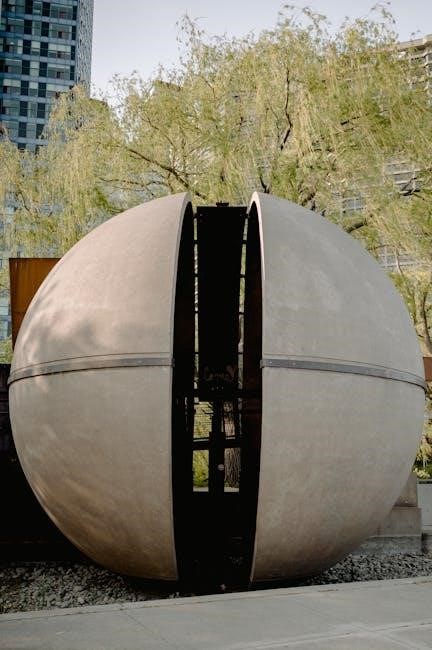
Furthermore‚ the concept extends to natural phenomena. Raindrops‚ while not perfect spheres‚ approximate this shape due to surface tension. Understanding the volume of these droplets is important in meteorological studies. Essentially‚ recognizing and calculating sphere volume provides a practical lens through which to view and understand the world around us.
Applications in Science and Engineering
In scientific fields‚ sphere volume calculations are paramount. Astronomers utilize these principles to determine the volume of planets‚ stars‚ and other celestial bodies‚ aiding in understanding their density and composition. Physicists apply sphere volume when studying atomic structures‚ modeling particles as spheres for simplified calculations.
Engineering disciplines heavily rely on this concept. Chemical engineers calculate the volume of spherical tanks used for storage‚ ensuring efficient capacity management. Material scientists determine the volume of spherical particles in composite materials‚ impacting strength and durability.
Moreover‚ medical imaging often involves analyzing spherical structures like cells or tumors‚ requiring accurate volume estimations for diagnosis and treatment planning. Even in nanotechnology‚ understanding the volume of nanoscale spheres is crucial for designing and manufacturing advanced materials. Precise volume calculations are therefore fundamental to innovation and progress across numerous scientific and engineering domains.
Resources for Sphere Volume Worksheets (PDF)
Numerous online platforms offer free‚ printable sphere volume worksheets in PDF format‚ alongside interactive calculators to reinforce learning and practice problem-solving skills effectively.
Where to Find Printable Worksheets
Locating sphere volume worksheets in PDF format is remarkably easy with the wealth of resources available online. Many educational websites specialize in math resources‚ offering a diverse collection of worksheets tailored to different skill levels. Websites like Math-Drills‚ K5 Learning‚ and Education.com frequently host printable PDFs covering sphere volume calculations.
A quick search on Google or your preferred search engine using keywords like “sphere volume worksheet PDF‚” “volume of a sphere practice problems‚” or “3D shapes volume worksheets” will yield numerous results. These searches often lead to dedicated worksheet pages or downloadable PDF documents. Teachers Pay Teachers is another excellent resource‚ offering both free and paid worksheets created by educators.
When selecting a worksheet‚ consider the complexity of the problems and whether they align with the learner’s current understanding. Some worksheets focus on basic calculations with given radii‚ while others incorporate more challenging scenarios involving diameters or require conversions between units. Always preview the worksheet to ensure it meets your specific needs before printing.
Online Sphere Volume Calculators
Alongside printable worksheets‚ numerous online sphere volume calculators provide instant results and can be valuable tools for checking answers or exploring different scenarios. These calculators eliminate the need for manual calculations‚ making them ideal for quick verification or when dealing with complex radii. Websites like Calculator.net‚ Omni Calculator‚ and MiniWebtool offer user-friendly sphere volume calculators.
Typically‚ these calculators require only the radius (or diameter) as input‚ instantly displaying the calculated volume. Some advanced calculators may also allow you to specify units of measurement. Utilizing these tools can enhance understanding by demonstrating the relationship between radius and volume.
While calculators are convenient‚ remember that the primary goal of using worksheets is to develop problem-solving skills. Therefore‚ it’s best to use calculators after attempting to solve problems manually. This approach reinforces the underlying concepts and ensures a deeper comprehension of sphere volume calculations‚ complementing the practice gained from PDF worksheets.